- US to Set Naval Blockade In Strait of Hormuz
- Why Gasoline Prices Could Remain High Despite Crude Price Fluctuation
- Global Conflict’s Impact on Farming Entering Planting Season
- Global Fertilizer Shortage
- Preparing for Summer Travel Season
- EIA April STEO Summary
US to Set Naval Blockade in Strait of Hormuz
- The United States has initiated a targeted blockade on Iranian-linked shipping in the Strait of Hormuz, using selective interdiction to restrict trade without fully closing the waterway.
- Oil markets have reacted sharply, with prices rising above $100 per barrel as supply risks increase, raising the likelihood of sustained volatility and higher global energy costs.
The United States has launched a targeted maritime blockade against vessels tied to Iranian ports following escalating tensions. Rather than a full closure, the operation relies on selective interdiction—using naval patrols, surveillance, mine-clearing, and potential boarding—to restrict Iranian-linked trade while maintaining broader transit. The strategy reflects both the geopolitical sensitivity and operational complexity of the region.
The impact on oil markets has been immediate, with crude prices rising above $100 per barrel as risk premiums increase. Even partial disruptions in such a critical choke point tighten global supply expectations and heighten volatility.
Russia and Iran are meeting given Russia’s reliance on stable global oil flows and its competition in export markets; the discussions reflect a shared interest in mitigating disruptions that could further destabilize energy markets.
Why Gasoline Prices Could Remain High Despite Crude Price Fluctuation
- Falling crude prices may not immediately translate to lower gasoline prices due to supply chain and inventory lags.
- Continued geopolitical uncertainty and seasonal demand could keep pump prices elevated in the near term.
While crude oil prices dropped sharply following cease-fire news, gasoline prices are expected to ease more slowly. The delay is largely due to the time it takes for higher-cost crude already in the system to be refined, distributed, and sold through existing inventories.
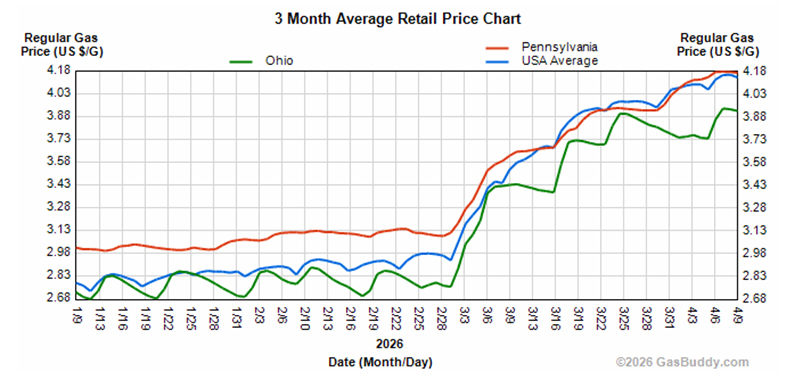
As a result, retail prices typically take longer to adjust on the way down than they do on the way up. At the same time, ongoing uncertainty around the cease-fire and peak seasonal demand are likely to keep a floor under gasoline prices in the near term, even as underlying costs begin to decline.
Global Conflict’s Impact on Farming Entering Planting Season
- Diesel and input costs surge: Diesel up 42% YoY to $5.07/gal, combined with volatile nitrogen-based fertilizers, is creating major financial pressures for farmers ahead of the 2026 planting season.
- Farmers adapt to rising costs: Variable rate technology and potential crop shifts from corn to soybeans reflect strategies to manage higher fuel and fertilizer expenses amid uncertain supply.
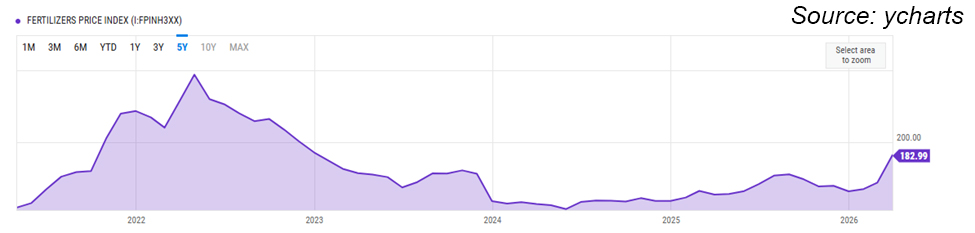
Diesel prices have surged 42% year-over-year, with the national average at $5.07 per gallon, creating major cost pressures for farmers ahead of the 2026 planting season. While DEF remains stable, careful monitoring of fuel use and field-level input costs is critical. Fertilizer markets—especially nitrogen-based products like “28” used for Ohio corn—are also volatile due to overseas supply disruptions.
Farmers are responding with variable rate technology to apply fertilizers more efficiently based on soil testing and field data. Some Midwest farmers may shift acreage from corn to soybeans in response to limited fertilizer availability, a trend that could gradually extend to Ohio. These adjustments combine technology and practical strategies to manage higher costs and uncertain supply.
Rising diesel costs are expected to affect the food supply chain, increasing expenses for planting, harvesting, and transportation. Analysts caution that if high diesel and input costs persist alongside low commodity prices, food prices may remain elevated, impacting consumer affordability for months to come.
Global Fertilizer Shortage
- Energy disruptions and China’s export restrictions are creating a global fertilizer shortage.
- Rising fertilizer costs and supply constraints threaten crop yields and tighter farmer margins.
Iran’s closure of the Strait of Hormuz has spiked oil and gas prices and created a global fertilizer shortage, threatening crop yields and raising agricultural costs amid slowing economic growth. These pressures come as 2026 may bring a strong El Niño, adding another layer of risk to global food production.
Fertilizer production is disrupted as Persian Gulf energy cuts and China’s export restrictions tighten global supply. Prices are surging just as spring planting begins, causing tighter margins and historically low U.S. Spring wheat planting.El Niño could alter rainfall patterns worldwide, triggering droughts in some regions and floods in others. NASA estimates it affects at least a quarter of global farmland, and a “super” El Niño could produce catastrophic weather. Combined with high temperatures and fertilizer shortages, this climate event could sharply reduce crop yields and worsen food insecurity globally
Preparing for Summer Travel Season
- Gasoline prices are forecast to peak near $4.30 per gallon in April and average over $3.70/gal in 2026.
- Airline fuel surcharges are rising as jet fuel prices have more than doubled in recent months.
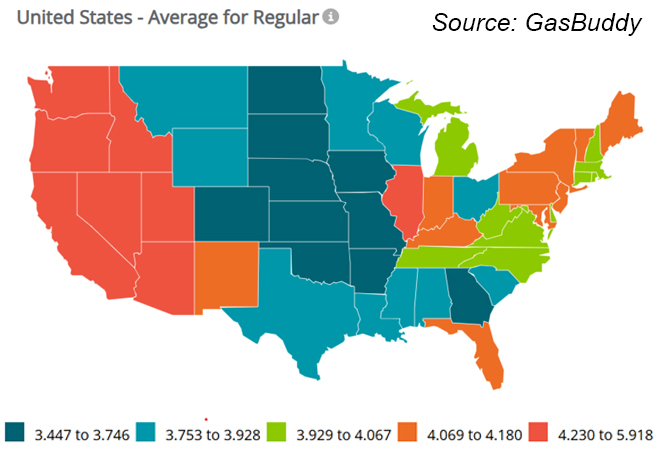
While driving patterns don’t usually change instantly with price fluctuations because gasoline is relatively inelastic, sustained elevated pump prices—forecast to peak near $4.30 per gallon in April and average more than $3.70/gal this year—tend to encourage people to rethink discretionary travel, like long road trips or vacations. Diesel prices, peaking above $5.80/gal in April and averaging $4.80/gal in 2026, remain particularly elevated due to tight global supplies and U.S. inventories below the five-year (2021–2025) average. As a result, people may choose shorter trips, stay closer to home, or delay nonessential travel to cut fuel costs, which in turn can moderate overall summer gasoline demand compared with typical seasonal levels.
Airline fuel surcharges are set to make summer travel noticeably more expensive. As jet fuel prices have surged—more than doubling in recent months, carriers are passing these costs directly to passengers through higher fuel fees and increased ancillary charges like checked baggage. This means ticket prices, especially for long-haul and international flights, are rising beyond standard seasonal increases, forcing travelers to budget more carefully or reconsider flight options this summer.
EIA STEO Summary – Updated April
Crude Oil Prices
Brent crude averaged $103 per barrel in March and is expected to peak at $115 in the second quarter of 2026 before easing below $90 by year-end. The Brent-WTI spread widened to $15 in April due to higher shipping costs and Middle East supply disruptions.
Gasoline & Diesel
Retail gasoline prices are forecast to average more than $3.70 per gallon in 2026, peaking near $4.30 in April. Diesel remains particularly high, exceeding $5.80 per gallon at its peak, due to tight global supplies and low U.S. inventories.
LNG & Natural Gas
U.S. LNG exports are running near peak capacity at nearly 18 billion cubic feet per day, limiting flexibility to increase shipments. Natural gas inventories are above the five-year average and expected to grow to 4,015 Bcf by October, 6% higher than the five-year norm.
Sources:
- Energy Information Administration (EIA)
- GasBuddy
- S&P Global
- Fox Business
- Trading Economics
- News Republic
- Ycharts